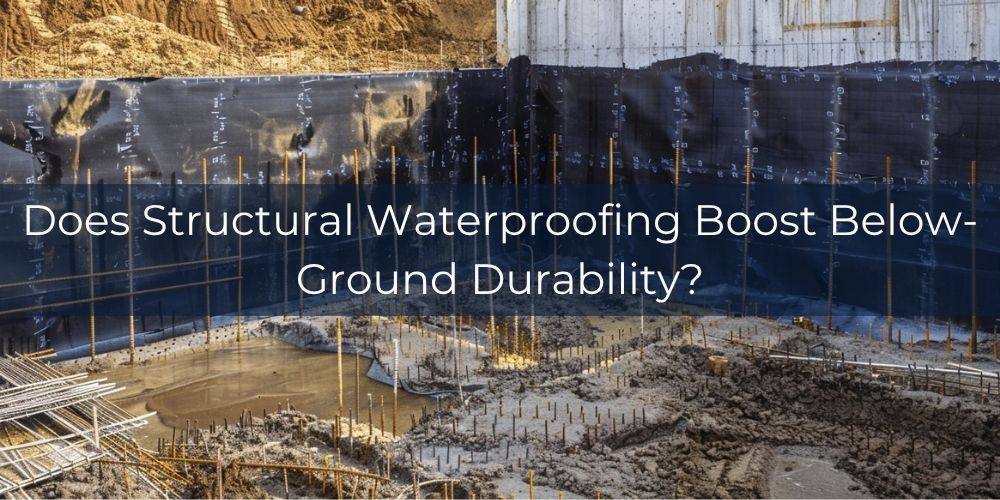
Structural waterproofing boosts below-ground durability by reducing the pathways through which groundwater, damp transfer, seepage, and hydrostatic pressure can damage buried construction in UK buildings. Basements, retaining walls, buried slabs, lift pits, foundation zones, and service basements all sit within conditions where moisture exposure is persistent rather than occasional. In these locations, durability is shaped by whether the below-ground structure can resist prolonged water contact without losing material integrity, interface stability, or long-term structural reliability. Structural waterproofing is therefore used as a durability-preservation measure for buried construction that must remain robust under continuous ground moisture stress. Below-ground durability is not preserved by product presence alone. It depends on whether the waterproofing system remains continuous across walls, slabs, joints, penetrations, terminations, and transitions where buried construction is most vulnerable to water tracking and long-term weakening. Once moisture enters at a wall-to-floor junction, construction joint, service penetration, or threshold interface, the resulting deterioration is rarely isolated. Water can migrate, remain trapped, increase reinforcement risk, destabilise bonded interfaces, degrade concrete surfaces, and shorten the reliable service life of the buried structure. Structural waterproofing boosts below-ground durability because it is designed to interrupt those failure routes before they become embedded defects within the construction. In UK projects, durability-led structural waterproofing must respond to actual site conditions, structural form, groundwater behaviour, substrate readiness, sequencing constraints, and interface ownership. That is why evidence-led assessment, buildable detailing, inspection discipline, and traceable installation control are central to durable below-ground protection. Structural Waterproofing delivers the works required to strengthen below-ground durability across buried structures, including waterproofing strategy development, membrane installation, coating application, joint sealing, penetration protection, transition detailing, remedial leak investigation, and phased waterproofing works for constrained or live environments. The objective is not simply to apply waterproofing materials. The objective is to preserve the long-term endurance of buried construction through controlled continuity, durable detailing, and verifiable installation. Where durability is the primary performance target, closeout evidence is also part of the protection strategy. Waterproofing zone records, continuity records, penetration-sealing photo sets, joint-treatment records, interface checks, and as-built documentation all help confirm how the waterproofing system was installed and where the durability-critical details sit within the structure. By combining moisture exclusion, interface discipline, system continuity, and recorded verification, structural waterproofing boosts below-ground durability across UK buildings and reduces the likelihood of progressive moisture-related decline.
What Does Structural Waterproofing Protect When Below-Ground Durability Is the Primary Objective?
When below-ground durability is the primary objective, structural waterproofing protects the buried structural condition that allows the construction to remain stable, sound, and resistant to moisture-driven decline over time. That protection includes concrete integrity, reinforcement security, interface cohesion, substrate condition, joint performance, and the long-term resilience of the below-ground assembly as a whole. In practice, structural waterproofing protects more than exposed surfaces. It protects the construction relationships that determine whether buried elements remain durable under sustained water exposure. Basements, retaining walls, buried slabs, lift pits, service basements, and foundation zones contain multiple continuity-sensitive interfaces where water can bypass isolated protection and begin to damage the structure indirectly. If continuity breaks at wall bases, kicker joints, penetrations, day joints, terminations, or changes between horizontal and vertical waterproofing zones, the durability risk increases because water can track into concealed parts of the structure and remain active over time. Structural waterproofing systems commonly include barrier membranes, coatings, joint-sealing components, penetration seals, puddle flanges, transition details, terminations, and supporting substrate-preparation measures. These elements only protect below-ground durability when they work together as one coordinated system. A structurally durable outcome depends on continuity across the full waterproofing zone, not on the local performance of one product in isolation. Where that continuity is missing, the durability consequences can escalate gradually. Dampness can develop into persistent seepage. Moisture retention can weaken concrete surfaces and bonded relationships. Reinforcement vulnerability can increase where water remains present for prolonged periods. Material fatigue can concentrate around high-stress interfaces. Structural waterproofing protects below-ground durability by reducing those exposure routes and by preserving the buried condition that allows the structure to retain strength, cohesion, and reliable long-term performance.
Why Does Structural Waterproofing Boost the Durability of Below-Ground Construction?
Structural waterproofing boosts the durability of below-ground construction because buried structures fail through accumulated moisture exposure, interface discontinuity, and long-term water movement rather than through isolated wetting events. Once a below-ground element is placed into service, it may remain exposed to groundwater pressure, perched water, lateral seepage, retained damp, and moisture transmission through buried interfaces for years. Durability is therefore governed by whether those water pressures are controlled continuously across the structure. This matters because below-ground deterioration is often progressive. Water does not need a large open route to reduce durability. It can exploit small weaknesses at joints, penetrations, slab edges, wall bases, terminations, and transitions between waterproofing zones. Once inside the build-up, it can track laterally, remain concealed, disrupt bonded interfaces, increase local stress on vulnerable details, and drive gradual structural decline. That is why structural waterproofing boosts durability only when it is treated as a complete below-ground protection system rather than as a standalone material application. UK buildings regularly intensify this problem. Variable ground conditions, constrained excavations, refurbishment interfaces, complex geometry, dense service penetrations, and programme pressure all increase the chance of incomplete continuity unless the waterproofing scope is planned and controlled properly. Structural waterproofing improves below-ground durability by aligning water-risk assessment, structural form, system selection, detailing logic, substrate preparation, sequencing, and inspection into one buildable and verifiable protection strategy. When those elements are coordinated, buried construction is better able to resist moisture-related weakening and retain durable structural performance over the long term.
Below-ground durability improvement depends on one core principle: moisture exclusion must remain continuous across the structural envelope and across the interfaces most likely to admit or retain water.
- Structural Waterproofing strengthens below-ground durability by defining waterproofing scope around full-envelope continuity rather than isolated treatment zones.
- Structural Waterproofing focuses attention on the buried details that most often control durability loss, including joints, penetrations, wall-to-floor interfaces, lift pits, thresholds, and terminations.
- Structural Waterproofing selects systems according to groundwater conditions, substrate character, detailing complexity, and the long-term endurance demands of the buried structure.
- Structural Waterproofing manages preparation, sequencing, access, protection, and trade coordination so durability-critical continuity is preserved through the construction process.
- Structural Waterproofing records installed works through inspection and closeout documentation so the durability strategy remains verifiable after completion.
These decisions produce the following durability and assurance outcomes.
- Full-envelope continuity control connects walls, slabs, joints, penetrations, terminations, and transitions into one protective system, so below-ground durability is strengthened across the buried structure.
- Durability-critical detail control secures the interfaces most likely to admit moisture or weaken over time, so localised water exposure is less able to develop into broader structural decline.
- Condition-matched system selection aligns waterproofing type with water exposure, substrate condition, and buried structural demands, so the installed system is more likely to remain durable in service.
- Sequenced installation control protects continuity through preparation, staging, temporary conditions, and trade overlap, so construction-phase disruption is less likely to damage the durability strategy.
- Recorded verification and closeout captures what was installed and how key interfaces were resolved, so the waterproofing system can be governed and maintained as a long-term durability measure.
The process below follows that same sequence, moving from continuity planning and interface risk through system selection, installation control, and verifiable closeout.
1. Define Waterproofing Scope Around Full Buried-Envelope Continuity
Below-ground durability begins with scope definition. Structural waterproofing cannot strengthen buried construction if the protection strategy only addresses obvious surfaces while leaving critical interfaces unresolved. Waterproofing scope has to cover the full buried envelope, including walls, slabs, joints, penetrations, transitions, terminations, and adjoining structural elements that influence moisture movement. The reason is simple: durability loss usually starts where continuity is broken, not where the main field area appears sound. Structural Waterproofing maps those continuity demands against the actual structural form so the waterproofing system is designed as one connected durability-preservation assembly.
2. Control the Buried Details Where Durability Loss Usually Begins
The highest durability risk often sits in the smallest details. Construction joints, day joints, wall-to-floor junctions, kicker joints, lift pits, service penetrations, thresholds, membrane stops, and changes in level are the places where buried waterproofing continuity is most likely to fail. These details combine geometry change, sequencing pressure, variable substrates, and multiple trade interfaces. They are therefore common starting points for moisture ingress and long-term weakening. Structural Waterproofing prioritises these durability-critical details because controlling them early reduces the hidden routes through which water can shorten the service life of buried construction.
3. Match the Waterproofing System to Exposure, Substrate, and Durability Demand
A durable below-ground outcome depends on using a waterproofing system that suits the real project conditions. Water pressure, retaining exposure, substrate variability, joint density, penetration frequency, refurbishment complexity, and access constraints all influence which system is appropriate. Some projects may suit cementitious protection where substrate control is reliable. Others may require bonded membranes or alternative barrier strategies where continuity demands are more complex. Structural Waterproofing evaluates these factors in relation to long-term buried performance, so the chosen system is not only specified on paper but remains technically suitable, buildable, and durable in practice.
4. Preserve Durability Continuity Through Sequencing, Preparation, and Trade Control
Even a well-chosen system can fail to improve durability if installation stages are poorly managed. Below-ground continuity is vulnerable during substrate preparation, temporary works, service installation, follow-on trades, access restrictions, and protection of completed areas. Structural Waterproofing organises the construction sequence so durability-critical details are installed in the correct order, on suitable backgrounds, and with the right protection before subsequent works proceed. This is essential because buried waterproofing is often concealed shortly after installation, which means sequencing errors can become embedded durability defects if they are not controlled at the time of the work.
5. Verify the Durability Strategy Through Records and Closeout Evidence
For below-ground durability, verification matters as much as installation. A waterproofing system cannot be treated as a dependable durability measure if continuity, joint treatment, penetration sealing, and interface resolution are not recorded during delivery. Structural Waterproofing captures the evidence needed to show how the buried protection system was formed, including continuity records, joint-treatment logs, penetration-sealing evidence, interface checks, and as-built documentation. Those records support future governance, maintenance, and technical accountability, while also confirming that the installed works were intended to preserve the long-term durability of the below-ground structure rather than merely satisfy a nominal specification.
How Does Structural Waterproofing Improve Below-Ground Durability in Practice?
Structural waterproofing improves below-ground durability in practice by controlling the specific moisture pathways that cause buried construction to weaken over time. In UK buildings, below-ground elements do not lose durability only because water is present in the ground. They lose durability when water reaches vulnerable structural interfaces, remains active within the construction build-up, and continues to attack the relationships that hold the buried assembly together. Practical durability improvement therefore depends on whether the waterproofing system prevents water entry, limits moisture tracking, protects junction integrity, preserves substrate condition, and reduces the long-term exposure burden placed on the structure.vIn real projects, durability is usually won or lost at the points where groundwater pressure, seepage movement, substrate condition, and detailing complexity intersect. A buried slab may remain durable if slab edges, joints, and transitions are fully protected, but it can begin to weaken if moisture reaches those details repeatedly and remains trapped around them. A retaining wall may remain structurally reliable if the waterproofing layer, joint treatment, and wall-to-base continuity are preserved, but it can deteriorate progressively if water bypasses one unresolved interface and begins to travel laterally through the construction. Structural waterproofing improves below-ground durability in practice because it reduces the opportunity for these small defects to become long-term structural liabilities. That practical improvement is never created by one action alone. It comes from how waterproofing is selected, detailed, sequenced, installed, protected, and verified across the buried structure. Waterproofing membranes, coatings, joint systems, penetration details, terminations, and transitions all contribute to durability only when they operate as one coordinated system across the whole below-ground zone. If one area is protected but adjoining details remain vulnerable, the durability gain becomes partial and unstable. Structural Waterproofing therefore approaches below-ground durability as a built outcome created by continuity, interface control, installation discipline, and evidence-led closeout rather than by nominal system selection alone.
Practical below-ground durability improvement depends on one repeatable rule: water must be kept away from the buried details most likely to weaken when exposure becomes prolonged, concealed, or difficult to reverse.
- Structural Waterproofing improves below-ground durability by restricting groundwater access to buried structural surfaces and limiting the moisture burden placed on the construction over time.
- Structural Waterproofing strengthens durability by protecting joints, penetrations, wall-to-floor interfaces, and other continuity-sensitive details where concealed weakness usually begins.
- Structural Waterproofing preserves substrate condition by ensuring the waterproofing system is applied to suitable backgrounds and tied into adjoining protection zones without exposed breaks.
- Structural Waterproofing reduces long-term deterioration risk by managing sequencing, protection, and follow-on trades so completed waterproofing details are not damaged or bypassed during construction.
- Structural Waterproofing confirms practical durability performance through inspection records, continuity checks, and closeout evidence that show how the buried protection system was actually formed.
These practical waterproofing actions produce the following durability and assurance outcomes.
- Groundwater exclusion at buried surfaces reduces repeated wetting and sustained moisture loading on structural elements, so below-ground components are less exposed to long-term deterioration pressure.
- Continuity protection at vulnerable details secures joints, penetrations, junctions, and transitions against hidden water entry, so local defects are less likely to develop into progressive structural weakness.
- Substrate-compatible waterproofing application supports adhesion, stability, and long-term system integrity, so the buried structure retains more reliable protection in service.
- Sequenced installation and protection control preserves completed waterproofing details during the build programme, so construction-stage disruption is less likely to compromise durability performance.
- Recorded inspection and closeout evidence shows how key waterproofing details were installed and resolved, so the durability strategy can be verified, governed, and maintained over time.
The practical durability sequence below follows that same logic, moving from groundwater exclusion and interface protection through substrate control, installation discipline, and recorded verification.
1. Restrict groundwater access to buried structural surfaces
The first practical way structural waterproofing improves below-ground durability is by reducing direct water access to the buried structure. Groundwater, retained damp, seepage pressure, and moisture transmission all place long-term stress on below-ground walls, slabs, bases, and adjoining interfaces. Where waterproofing forms a continuous protective barrier, the structural surface is exposed to a lower and more controlled moisture burden. That matters because durability is influenced not just by whether water arrives once, but by whether buried construction remains under repeated or continuous moisture attack across its service life. Structural Waterproofing improves durability in practice by installing systems that interrupt that exposure pattern before it becomes a persistent source of structural weakening.
2. Protect the interfaces where concealed deterioration usually starts
Below-ground durability often fails first at details rather than in open field areas. Construction joints, day joints, wall-to-floor junctions, kicker joints, penetrations, thresholds, lift pits, and changes between vertical and horizontal waterproofing zones all create opportunities for water to bypass the main protective layer. Once moisture enters at one of these details, it can remain concealed, migrate laterally, and begin to weaken the surrounding construction without immediate visibility. Structural Waterproofing improves durability in practice by concentrating design and installation attention on these continuity-sensitive interfaces, because that is where small waterproofing defects most often grow into long-term buried deterioration.
3. Preserve substrate condition so the waterproofing system can perform reliably
Durability improvement depends on what the waterproofing is applied to as much as on the waterproofing itself. Unsuitable substrates, contamination, poor preparation, surface irregularity, weak edges, and unresolved background defects all increase the chance that continuity will be lost after installation. If the substrate is unstable or unready, the waterproofing layer may not remain properly integrated with the structure over time. Structural Waterproofing improves below-ground durability in practice by controlling substrate readiness before critical waterproofing works proceed, ensuring that membranes, coatings, and associated detailing are applied to backgrounds capable of supporting durable long-term protection.
4. Maintain waterproofing integrity through sequencing and trade coordination
Many below-ground durability failures are introduced during construction rather than during design. Waterproofing details can be damaged by temporary works, follow-on trades, access restrictions, service installation, protection failures, or poor sequencing between adjoining packages. A detail that was correctly installed can still lose durability value if it is punctured, bridged, contaminated, or concealed before continuity is checked. Structural Waterproofing improves durability in practice by controlling the build sequence around the waterproofing system so critical details are installed in the right order, protected after completion, and not undermined by later site activity.
5. Verify the practical durability gain through inspection and recorded evidence
Practical durability improvement is only dependable if it can be demonstrated. Below-ground waterproofing becomes concealed, buried, or difficult to inspect once later construction stages progress, which means unrecorded details quickly become unverifiable details. Structural Waterproofing improves below-ground durability in practice by capturing the evidence that shows where continuity was formed, how joints and penetrations were treated, and how adjoining protection zones were resolved. Continuity records, joint-treatment logs, photographic evidence, interface checks, and as-built documentation all help confirm that the durability strategy was implemented as intended and can still be governed after the buried works are no longer visible.
Have a question about an upcoming project?
What Usually Reduces Below-Ground Durability When Structural Waterproofing Is Missing, Incomplete, or Broken?
Below-ground durability is usually reduced when structural waterproofing is missing, incomplete, or broken because buried construction then remains exposed to the kinds of moisture conditions that steadily shorten structural life rather than preserving long-term endurance. In UK buildings, durability loss below ground is rarely caused by one dramatic event alone. It more often develops when groundwater, seepage, damp transmission, or hydrostatic pressure is allowed to remain active within the buried build-up through an unresolved junction, an incomplete tie-in, a weak penetration detail, a failed termination, or a continuity break between adjoining waterproofing zones. Once that moisture burden is no longer excluded, the structure is subjected to repeated wetting, concealed saturation, interface stress, and cumulative weakening that reduce its long-term durability. This matters because below-ground durability is governed by prolonged exposure, not just by visible symptoms. A buried wall, slab, base, or interface can begin to lose service-life reliability long before obvious failure appears at surface level. Repeated moisture activity at a wall base, chronic seepage at a construction joint, trapped dampness around a penetration cluster, or concealed wetting behind an incomplete transition can gradually reduce concrete integrity, weaken bonded relationships, increase reinforcement vulnerability, destabilise local interfaces, and erode the dependable endurance of the buried assembly. Structural waterproofing boosts below-ground durability because it is intended to prevent exactly these forms of progressive deterioration. When the waterproofing system is absent, incomplete, or compromised, those durability-loss mechanisms remain active inside the structure instead of being shut down at the envelope. In practice, below-ground durability is most often reduced not by the absence of one product in one location, but by loss of continuity across the wider protective system. A membrane may stop short at a threshold. A coating may fail to return properly into a wall-to-floor junction. A penetration may remain insufficiently sealed. A termination may be weak. A buried interface may be damaged during later works. Each of these failures creates a condition in which moisture can remain active for long enough to reduce structural endurance over time. Structural Waterproofing therefore treats durability loss as a continuity-loss problem rather than as a surface damp problem, because once continuity is broken, buried decline can continue long after the original defect has been concealed from view.
Below-ground durability is usually reduced when moisture is allowed to stay active within buried construction at the exact details where long-term weakening is most likely to accumulate, least likely to be seen early, and hardest to reverse once established.
- Structural Waterproofing identifies missing waterproofing scope as a durability-loss condition because unprotected buried areas remain exposed to repeated moisture loading that steadily shortens long-term structural endurance.
- Structural Waterproofing treats incomplete continuity as a durability threat because partially protected systems still leave water-entry routes open at junctions, penetrations, thresholds, terminations, and transitions where progressive weakening can begin.
- Structural Waterproofing treats broken waterproofing as a durability-loss trigger because punctured, displaced, bridged, bypassed, or otherwise compromised protection can reactivate concealed moisture exposure inside the buried build-up.
- Structural Waterproofing concentrates on continuity-sensitive details because local defects at buried interfaces are the places where service-life reduction and cumulative structural decline most often begin.
- Structural Waterproofing treats undetected buried defects as a durability multiplier because hidden moisture activity that is not identified early is more likely to persist long enough to deepen structural weakening over time.
These durability-loss conditions produce the following structural and performance consequences.
- Repeated buried moisture loading keeps groundwater, seepage, and damp transmission active against the structure, so below-ground elements are subjected to a higher long-term deterioration burden.
- Continuity-break endurance loss allows water to enter at vulnerable details and stay active within concealed parts of the build-up, so local weaknesses are more likely to develop into broader buried decline.
- Interface weakening reduces bonded stability, junction reliability, and detail performance where moisture remains active over time, so the buried assembly becomes less durable in service.
- Progressive concealed deterioration allows long-term weakening to continue behind finishes, within junctions, and around buried interfaces without early visibility, so the durability problem is more likely to deepen before intervention occurs.
- Reduced service-life confidence shortens the period for which the buried construction can be expected to perform robustly under moisture stress, so long-term structural reliability becomes less dependable.
The durability-loss sequence below follows that same logic, moving from missing protection and continuity failure through concealed moisture activity, interface weakening, and long-horizon structural decline.
1. Missing waterproofing leaves buried structural surfaces exposed to sustained moisture stress
When structural waterproofing is missing altogether, below-ground durability is reduced because buried walls, slabs, bases, and adjoining details remain directly exposed to groundwater, seepage, and damp transmission without a continuous moisture-exclusion layer. In that condition, the structure has no full defensive route to interrupt moisture before it reaches the buried build-up. Repeated or prolonged exposure then becomes part of the working condition of the structure itself. Structural Waterproofing treats this as a durability problem from the outset because buried construction cannot retain long-term endurance if moisture loading is allowed to remain normalised across unprotected structural surfaces.
2. Incomplete waterproofing leaves hidden durability gaps at continuity-sensitive details
Below-ground durability is also reduced when waterproofing is present in some areas but incomplete across the full buried envelope. This commonly occurs where walls are protected but wall bases are unresolved, where field areas are treated but penetrations remain weak, or where adjoining waterproofing zones fail to tie together properly. Incomplete continuity does not remove durability risk. It concentrates durability loss at the buried locations where moisture can still bypass the protection and remain active against the surrounding structure. Structural Waterproofing therefore treats incomplete waterproofing as a system-level endurance defect rather than as a minor local omission.
3. Broken waterproofing reopens the conditions that drive long-term buried decline
Even where waterproofing was originally designed and installed correctly, below-ground durability can still be reduced if that protection becomes broken during or after installation. Puncture, displacement, bridging, substrate failure, trade damage, contamination, or poor reinstatement can reopen the moisture conditions that the original system was meant to exclude. Once that happens, water may again begin to track through concealed interfaces, collect around penetrations, or remain active at buried transitions. Structural Waterproofing treats broken waterproofing as a durability-loss trigger because the reactivation of concealed moisture exposure allows cumulative weakening to resume inside the build-up.
4. Moisture retained at buried interfaces gradually erodes structural endurance
Below-ground durability is rarely lost in one step. It is more often reduced gradually where moisture remains trapped or repeatedly active at wall-to-floor junctions, construction joints, penetrations, thresholds, lift pits, slab edges, and other continuity-sensitive details. At these buried interfaces, moisture can disturb bonded relationships, undermine junction integrity, increase reinforcement vulnerability, weaken local substrates, and create persistent stress around already vulnerable details. Structural Waterproofing focuses heavily on these locations because they are the points where long-term buried endurance most often begins to erode and where durability recovery becomes hardest once deterioration is established.
5. Hidden defects that remain active for too long deepen long-term durability loss
Below-ground durability is further reduced when missing, incomplete, or broken waterproofing leaves concealed defects active for long enough that structural weakening becomes embedded before it is properly identified. Once buried works are covered, latent moisture activity can continue without early visibility, allowing deterioration to deepen across adjoining details and interfaces. Structural Waterproofing treats early detection as part of durability preservation for this reason. Where concealed moisture exposure is left active over time, the buried structure becomes more exposed not only to immediate weakening, but also to accelerating service-life loss and more disruptive remediation later.
When Should Below-Ground Durability Be Assessed?
If a below-ground structure has recurring leakage, suspected moisture tracking, unresolved damp transmission, prolonged groundwater exposure, or uncertainty around waterproofing continuity at wall-to-floor junctions, joints, penetrations, thresholds, terminations, and buried interface details, below-ground durability should be assessed before concealed deterioration, interface weakening, and long-term structural decline become embedded into the construction. Durability risk is rarely defined by visible moisture symptoms alone. Retaining walls, buried slabs, lift pits, service basements, foundation zones, wall bases, penetrations, membrane stops, and transitions between horizontal and vertical waterproofing zones often determine whether buried construction is retaining its long-term endurance as intended. On new-build and refurbishment projects, delayed action also increases technical and programme risk by allowing continuity failures, inaccessible defects, substrate weakness, and trade-interface damage to become harder to diagnose and more difficult to correct once the below-ground structure is enclosed, advanced, or operational. Below-ground durability should therefore be assessed as a complete waterproofing and moisture-exposure condition under real site circumstances, using evidence-led review of groundwater behaviour, structural form, substrate readiness, continuity risk concentration, and the buried details most likely to weaken over time. This allows durability loss, moisture exposure, and detailing weakness to be understood as system-level structural issues rather than isolated damp symptoms or repeat local defects. Where required, the next technically correct step may be durability review, waterproofing investigation, interface assessment, targeted remedial correction, or a coordinated below-ground protection strategy for wider long-term control. If your below-ground structure has recurring moisture symptoms, uncertain buried detailing, missing waterproofing records, or any doubt about whether long-term durability is being preserved properly, request a below-ground durability assessment or waterproofing scope review to determine the correct technical pathway for the structure.