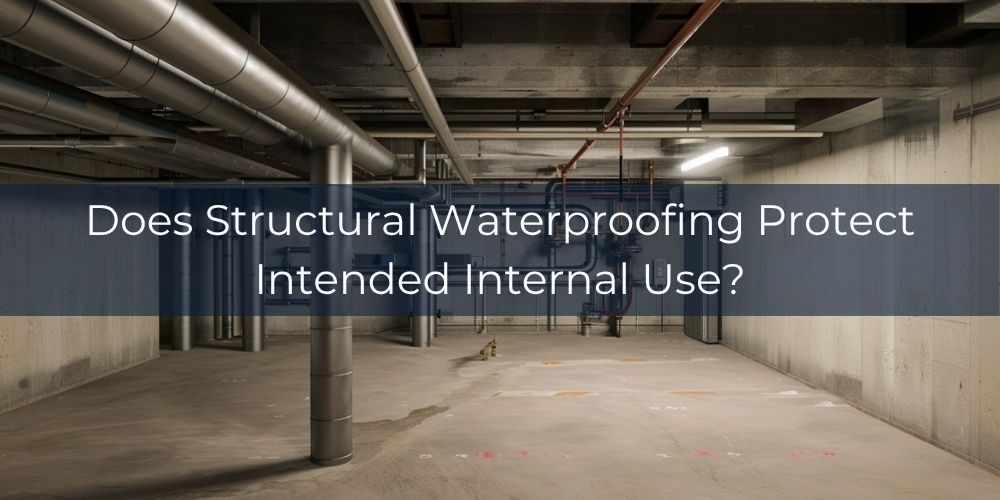
Structural waterproofing protects intended internal use by keeping water, damp spread, seepage, and moisture instability from disrupting how a below-ground or water-exposed space is meant to function in UK buildings. Basements, lower-ground rooms, service basements, plant rooms, lift pits, retaining-side spaces, and other buried or partially buried zones often have a defined operational purpose after completion. That purpose may involve circulation, storage, plant access, equipment operation, maintenance activity, habitable occupation, or controlled service distribution. Structural waterproofing protects intended internal use because a space cannot remain fit for its planned role if water entry changes its environmental condition, restricts access, damages finishes, or interferes with reliable day-to-day use. The central issue is functional suitability, not product presence. A waterproofed space only remains usable if moisture is prevented from entering the structure, tracking through interfaces, spreading across surfaces, or creating the kind of conditions that undermine practical occupation and operation. Water at a wall base, a construction joint, a service penetration, or a floor transition does not remain a local issue for long. It can stain finishes, destabilise environmental conditions, affect stored materials, interrupt plant access, increase cleaning and maintenance burdens, and reduce confidence that the space can perform as intended. Structural waterproofing protects intended internal use because it is designed to preserve the internal conditions on which that intended use depends. In UK projects, intended-use protection has to respond to the actual role of the space, the severity of water exposure, the shape of the structure, the readiness of the substrate, and the practical constraints of the build sequence. A service basement does not have the same use-sensitive risk profile as a habitable lower-ground room, and a plant space does not carry the same operational requirements as a storage area. Structural waterproofing therefore has to be developed around use-based performance requirements rather than around generic material selection. Structural Waterproofing delivers the works needed to protect intended internal use across buried and water-vulnerable spaces, including waterproofing strategy development, membrane installation, coating application, joint sealing, penetration detailing, transition treatment, leak investigation, and phased installation for constrained or live construction environments. The aim is to preserve a usable internal environment, not merely to apply a nominal protective layer. Where internal use is the key outcome, project records also matter because they support long-term assurance that the space was protected in line with its operational role. Waterproofing zone records, continuity records, penetration-sealing evidence, joint-treatment logs, interface checks, and as-built layouts help show how the installed system supports the internal environment that the space was meant to maintain. By combining water exclusion, interface control, use-based detailing, and recorded verification, structural waterproofing protects intended internal use across UK buildings and reduces the risk that the completed space becomes operationally compromised by moisture.
What Does Structural Waterproofing Protect When Intended Internal Use Is the Primary Objective?
When intended internal use is the primary objective, structural waterproofing protects the internal conditions that make a space usable for the purpose it was designed to serve. That includes dryness, environmental stability, safe access, finish reliability, plant operability, storage suitability, service continuity, and the wider operational dependability of the protected area. This means structural waterproofing is not only protecting structure in an abstract sense. It is protecting the practical performance environment inside the building envelope. A lower-ground room intended for occupation needs different internal conditions from a plant room designed for equipment access, and a service basement used for utilities must remain functional in a different way from a storage zone holding vulnerable materials. In each case, intended internal use depends on whether moisture is kept out of the space and away from the details that could spread water, generate dampness, destabilise conditions, or interrupt normal use. Structural waterproofing systems commonly bring together barrier membranes, coatings, joint-sealing elements, penetration seals, puddle flanges, transition details, terminations, and substrate-preparation measures. These only protect intended internal use when they work together as one coordinated waterproofing system across the whole protected zone. If continuity breaks at wall-to-floor interfaces, service entries, day joints, thresholds, lift pits, or changes between horizontal and vertical protection zones, moisture can enter and start affecting the conditions that the space depends on. That may mean wet surfaces, staining, humidity instability, hygiene concerns, equipment vulnerability, reduced accessibility, or direct loss of use. Structural waterproofing protects intended internal use by preserving the operational and environmental conditions that allow a space to function properly after handover. It safeguards the internal setting in which the planned use can continue without water-driven disruption, and it reduces the likelihood that the space becomes unreliable, restricted, or unsuitable once in service.
Why Does Structural Waterproofing Protect Intended Internal Use?
Structural waterproofing protects intended internal use because the value of a below-ground or water-exposed space depends on whether that space can still perform its intended role after the building enters service. If water reaches the internal environment, the problem is not limited to materials becoming wet. The real issue is that the planned use of the space can start to fail. Access routes can become unreliable, plant areas can become harder to maintain, stored items can become vulnerable, finishes can become stained or unstable, and spaces intended for occupation or controlled use can lose the environmental quality they were meant to provide. This risk grows quickly in below-ground conditions because water pressure, seepage movement, retained damp, and concealed moisture routes all increase the chance of disruption at the exact interfaces where internal environments are most easily compromised. Junctions, penetrations, thresholds, slab edges, wall bases, and transition points are not just technical details. They are the locations where operational suitability can be lost if moisture moves past incomplete protection and begins to affect the usable side of the structure. Structural waterproofing protects intended internal use because it controls those routes before they alter the internal conditions on which the space depends. UK buildings often intensify the challenge. Constrained sites, refurbishment interfaces, mixed-use lower-ground layouts, variable groundwater behaviour, dense service penetrations, and programme pressure all increase the risk that internal-use protection will fail if the waterproofing scope is not planned as a full system. Structural waterproofing protects intended internal use by combining water-risk assessment, use-based performance criteria, detailing logic, system selection, substrate control, sequencing, and verification into one coordinated delivery strategy. When those parts are aligned, the completed space is far more likely to remain dry, usable, serviceable, and operational in the way it was originally intended.
Protection of intended internal use depends on one governing rule: the internal environment must remain suitable for the planned function of the space after construction is complete and after water exposure begins.
- Structural Waterproofing protects intended internal use by defining waterproofing scope around the environmental and operational requirements of the space rather than around generic below-ground treatment alone.
- Structural Waterproofing concentrates on the interfaces where moisture most often disrupts function, including joints, penetrations, wall bases, thresholds, lift pits, service entries, and level changes.
- Structural Waterproofing selects systems according to water exposure, substrate condition, detailing complexity, and the sensitivity of the planned use within the protected space.
- Structural Waterproofing coordinates preparation, sequencing, access, and protection measures so internal-use performance is not undermined during installation or by later trades.
- Structural Waterproofing records installed works through inspection and closeout evidence so the intended-use protection strategy remains demonstrable after completion.
These decisions produce the following usability and assurance outcomes.
- Use-defined waterproofing scope aligns protection with how the space is meant to operate, so intended internal use is protected in a way that reflects the actual purpose of the area.
- Interface-led disruption control secures the details where moisture is most likely to interrupt access, stability, cleanliness, or operability, so local water ingress is less likely to become broader usability failure.
- Use-sensitive system selection matches the waterproofing approach to the exposure level and the sensitivity of the internal environment, so the protected space is more likely to remain fit for purpose in service.
- Sequenced delivery protection preserves continuity through preparation, staging, access constraints, and trade overlap, so waterproofing integrity is less likely to be lost before the space is completed.
- Recorded closeout assurance captures how the protection system was installed and resolved at key details, so the intended-use strategy can be verified, governed, and maintained over the building lifecycle.
The process below follows that same sequence, moving from use-defined scope and disruption-point control through system selection, construction-stage protection, and verifiable closeout.
1. Define the Waterproofing Scope Around the Planned Function of the Space
Protection of intended internal use begins with the role the space is meant to serve. A habitable lower-ground room, a service basement, a plant room, and a storage zone do not all require the same environmental outcome. The waterproofing scope therefore has to reflect the actual use of the space, because the relevant question is not simply whether water can reach the structure, but whether water can alter the conditions needed for that space to perform properly. Structural Waterproofing defines the scope around the operational and environmental demands of the completed area so the installed system supports the actual function of the protected space.
2. Control the Moisture-Entry Points Most Likely to Disrupt Use
Loss of intended internal use often starts at relatively small details. Construction joints, wall-to-floor junctions, service penetrations, thresholds, membrane stops, lift pits, and transitions between vertical and horizontal waterproofing zones are frequent sources of moisture movement into usable space. When those details are not resolved properly, water can spread beyond the immediate point of entry and begin to affect floors, finishes, access routes, equipment areas, or service zones. Structural Waterproofing prioritises these function-critical disruption points because they often determine whether the internal environment remains suitable once the building is occupied, commissioned, or brought into operational use.
3. Select the Waterproofing System According to Use Sensitivity as Well as Exposure
The right waterproofing system is not chosen only by looking at water pressure or substrate condition. It also has to reflect how sensitive the completed space is to moisture disruption. A room intended for occupation, storage, plant maintenance, or controlled service distribution may become unsuitable at a different threshold of moisture impact. Structural Waterproofing evaluates exposure, substrate character, detailing complexity, and the practical sensitivity of the intended use so the selected system is not only technically appropriate but also aligned to the conditions that the finished space must maintain.
4. Preserve Intended-Use Protection Through Sequencing and Site Coordination
A waterproofing strategy can be logically sound at design stage and still fail to protect intended internal use if it is damaged, bypassed, or compromised during construction. Temporary works, access restrictions, service installation, follow-on trades, poor protection of completed areas, and sequencing errors can all weaken continuity before the internal space is handed over. Structural Waterproofing manages sequencing and trade coordination so the details that protect the future usability of the space remain intact through installation, interface works, and later construction activity.
5. Verify That the Completed Space Was Protected for Its Planned Use
If the waterproofing works are concealed without inspection records and closeout evidence, the intended-use protection strategy becomes much harder to verify later. Structural waterproofing protects intended internal use most reliably when the installed details can be traced, checked, and governed after completion. Structural Waterproofing records continuity, joint treatment, penetration sealing, interface resolution, and as-built layout information so the completed works can be understood in relation to the operational purpose of the space. That evidence helps confirm that the finished environment was protected in a way that supports its intended internal use rather than merely satisfying a generic waterproofing specification.
How Does Structural Waterproofing Perform Its Primary Objective of Protecting Intended Internal Use?
Structural waterproofing protects intended internal use by keeping external water exposure from altering the internal conditions that a completed space depends on. In UK buildings, basements, lower-ground rooms, service basements, plant rooms, lift pits, and other water-vulnerable structural zones do not lose functional value only when visible water appears. They lose functional value when damp spread, seepage, staining, humidity instability, surface wetting, or restricted access begin to interfere with the role the space was designed to perform. Structural waterproofing therefore serves its primary objective by preserving internal suitability after construction, not merely by resisting water at isolated points. That objective is use-led. A plant room must remain accessible, maintainable, and operationally stable. A storage space must remain dry enough to protect stored materials from damp-related deterioration. A lower-ground occupied area must retain clean, reliable, and serviceable internal conditions. In each case, Structural Waterproofing protects intended internal use by stopping moisture from crossing the envelope, spreading through interfaces, or accumulating around the details that control usability. This is why the protection strategy has to function as a coordinated internal-environment safeguard rather than as a single-product treatment. Membranes, coatings, joint-sealing systems, penetration details, puddle flanges, terminations, transitions, and substrate-preparation measures only achieve the objective when they work together across the full protected zone. If one wall base, threshold, penetration cluster, or floor transition is left weak, moisture can begin to affect the space in ways that exceed the size of the original defect. Structural Waterproofing protects intended internal use by controlling those disruption routes before they become operational problems inside the completed space.
Structural Waterproofing protects intended internal use by ensuring that water pressure outside the structure does not become usability failure inside the structure.
- Structural Waterproofing protects intended internal use by preventing groundwater, seepage, and damp transmission from entering spaces that must remain usable, accessible, and operational after completion.
- Structural Waterproofing protects intended internal use by securing joints, penetrations, wall bases, thresholds, lift pits, and transitions where local moisture entry most often disrupts the planned function of a space.
- Structural Waterproofing protects intended internal use by matching the waterproofing system to both the site water risk and the sensitivity of the internal environment being protected.
- Structural Waterproofing protects intended internal use by preserving continuity through substrate preparation, installation sequencing, access planning, and trade coordination during the build process.
- Structural Waterproofing protects intended internal use by recording interface treatment, continuity evidence, and installed details so the protection strategy remains verifiable after handover.
These protection decisions produce the following internal-use and assurance outcomes.
- Envelope-level moisture exclusion keeps water pressure and damp movement from passing into the protected zone, so the internal space is more likely to remain dry, serviceable, and fit for purpose.
- Disruption-point control secures the details where minor defects most often become operational problems, so local ingress is less likely to escalate into broader loss of use.
- Use-matched system selection aligns the waterproofing approach with both exposure severity and internal performance demands, so the completed space is better protected for its actual role.
- Construction-stage continuity preservation reduces the risk that sequencing errors, damaged details, or follow-on trades will weaken the internal-use protection strategy before completion.
- Evidence-based closeout assurance shows how the installed works support the planned function of the space, so intended internal use can be verified, governed, and maintained over the building lifecycle.
The sequence below follows that same logic, moving from moisture exclusion and disruption-point control through system matching, continuity preservation, and recorded verification.
1. Keep external moisture out of the usable side of the structure
The first way Structural Waterproofing protects intended internal use is by stopping groundwater, seepage, damp transmission, and moisture migration from crossing into the internal side of the structure. Intended internal use depends on whether the completed space remains suitable for occupation, access, storage, maintenance, plant operation, or controlled service distribution once external water exposure begins. When the waterproofing system forms a continuous barrier across walls, floors, joints, and adjoining interfaces, the internal environment is far more likely to retain the conditions the space was designed to support.
2. Secure the details where loss of use usually starts
Loss of intended internal use usually begins at local details rather than broad open areas. Wall-to-floor junctions, penetrations, thresholds, lift pits, construction joints, membrane stops, and changes between waterproofing zones are the places where water can bypass otherwise sound protection and begin to affect the internal environment. Once that happens, moisture can spread into finishes, access paths, equipment zones, storage areas, or occupied parts of the space. Structural Waterproofing protects intended internal use by prioritising these disruption-prone interfaces, because this is where small continuity failures most often become practical loss of function.
3. Match the system to the sensitivity of the intended use
The waterproofing strategy must reflect what the completed space actually needs to remain fit for purpose. A service basement, a plant room, a lower-ground occupied room, and a storage area do not all have the same tolerance for moisture-related disruption. Structural Waterproofing protects intended internal use by selecting systems that respond not only to groundwater behaviour, substrate condition, and detailing complexity, but also to the sensitivity of the internal environment being protected. That keeps the protection strategy aligned with the real performance demands of the finished space.
4. Preserve continuity through sequencing and trade control
A technically suitable waterproofing design can still fail to protect intended internal use if continuity is damaged during construction. Temporary works, service installation, restricted access, follow-on trades, poor protection of completed areas, and sequencing errors can all weaken the details responsible for preserving the internal environment. Structural Waterproofing protects intended internal use by coordinating preparation, staging, access, and interface management so those details remain intact through installation, follow-on activity, and handover.
5. Prove that the completed space was protected for its planned role
Protection of intended internal use is strongest when the installed details can still be understood after they are concealed. Structural Waterproofing protects intended internal use by capturing continuity records, joint-treatment evidence, penetration-sealing records, interface checks, and as-built layout information that connect the installed works to the planned function of the space. This matters because many of the details that determine future usability become inaccessible once later construction stages are complete. Closeout evidence helps confirm that the finished environment was protected in a way that supports its intended internal use over time.
Have a question about an upcoming project?
What Usually Prevents Structural Waterproofing from Protecting Intended Internal Use?
Structural waterproofing usually fails to protect intended internal use when moisture is still able to alter the internal conditions that the space depends on after completion. In UK buildings, loss of intended use rarely begins with a large obvious failure across the whole area. It more often begins when groundwater, seepage, damp transmission, or localised moisture spread is allowed to bypass the protective envelope at a wall base, penetration, threshold, construction joint, membrane stop, transition, or other continuity-sensitive detail. Once that happens, the problem is no longer limited to water at one point in the structure. It becomes a functional problem inside the space, because the internal environment begins to drift away from the conditions that the intended use requires. This matters because intended internal use is not preserved by product presence alone. A space remains fit for purpose only when moisture is prevented from entering, spreading, accumulating, or destabilising the operational side of the structure. A plant room can lose maintainable access. A storage zone can lose dryness and material reliability. A lower-ground occupied space can lose environmental stability. A service basement can lose operational confidence if dampness begins affecting service routes, equipment surroundings, or maintenance areas. Structural waterproofing therefore fails to protect intended internal use whenever continuity is weak enough for water to convert from an external exposure condition into an internal usability problem. In practice, intended internal use is most often undermined by incomplete continuity, weak interface detailing, unresolved penetrations, damaged protection, unsuitable substrate conditions, or later works that compromise previously formed waterproofing routes. A membrane may stop short of a threshold. A penetration may not be fully sealed. A wall-to-floor tie may remain weak. A termination may be poorly resolved. A finished detail may be damaged by later trades. Each of these conditions can allow moisture to affect the usable side of the structure in ways that exceed the size of the original defect. Structural Waterproofing therefore treats loss of intended internal use as a continuity-failure problem rather than as a surface damp problem, because once moisture reaches the internal environment, the planned function of the space can begin to fail progressively.
Structural waterproofing usually stops protecting intended internal use when moisture is allowed to reach the internal side of the structure at the exact details where access, operability, cleanliness, environmental stability, or functional suitability are easiest to disrupt and hardest to restore once affected.
- Structural Waterproofing identifies missing waterproofing scope as a use-protection failure because unprotected buried areas can still allow moisture to affect the internal conditions that the space depends on.
- Structural Waterproofing treats incomplete continuity as a usability threat because partially protected systems still leave entry routes open at joints, penetrations, thresholds, terminations, and transitions where internal disruption can begin.
- Structural Waterproofing treats broken waterproofing as a use-loss trigger because damaged, displaced, punctured, bridged, or bypassed protection can reactivate moisture pathways into the completed space.
- Structural Waterproofing focuses on continuity-sensitive details because local failures at buried interfaces are the places where intended internal use is most often undermined first.
- Structural Waterproofing treats unverified concealed works as an operational risk because hidden defects are harder to identify before they begin affecting the functional condition of the space.
These use-protection failures produce the following internal-environment and operational consequences.
- Internal-condition instability allows dampness, seepage, staining, or moisture spread to affect the usable side of the structure, so the space becomes less reliable for its planned role.
- Continuity-break disruption risk allows water to enter at vulnerable details and move beyond the original entry point, so local defects are more likely to become wider usability problems.
- Interface-led loss of function weakens the details that support access, finish stability, equipment surroundings, storage conditions, or serviceability, so the operational environment becomes less dependable.
- Progressive use degradation allows moisture-related disruption to continue without early correction, so the internal space is more likely to become restricted, unreliable, or unfit for purpose over time.
- Reduced confidence in planned use undermines trust that the completed area can perform consistently under real conditions, so the intended internal role of the space becomes less secure.
The use-failure sequence below follows that same logic, moving from missing protection and continuity loss through internal moisture disruption, interface-related functional decline, and broader loss of intended use.
1. Missing waterproofing leaves the internal environment exposed to moisture disruption
When structural waterproofing is missing altogether, intended internal use is harder to preserve because the buried structure has no continuous system preventing external water exposure from affecting the usable side of the build-up. In that condition, groundwater, seepage, and damp transmission can remain active against the structure without a complete moisture-control route to interrupt them. Structural Waterproofing treats this as a use-protection failure from the outset because a space cannot remain dependable for occupation, storage, plant access, service distribution, or maintenance if external moisture is free to influence the internal environment.
2. Incomplete waterproofing leaves hidden use-disruption gaps at continuity-sensitive details
Structural waterproofing also fails to protect intended internal use when it is present in some areas but incomplete across the full protected zone. This commonly occurs where walls are treated but wall bases remain weak, where field areas are protected but penetrations are unresolved, or where adjoining waterproofing zones fail to tie together properly. Incomplete continuity does not preserve the practical function of the space. It simply relocates the disruption risk to the buried details where moisture can still bypass the protection and begin affecting the internal environment. Structural Waterproofing therefore treats incomplete waterproofing as a system-level usability defect rather than as a minor local omission.
3. Broken waterproofing reopens the moisture routes that undermine internal use
Even where waterproofing was originally appropriate, intended internal use can still be compromised if the installed protection becomes broken during or after construction. Puncture, displacement, bridging, trade damage, contamination, substrate failure, or poor reinstatement can reopen moisture routes at details that were previously controlled. Once that happens, dampness or seepage may again begin to affect finishes, access routes, equipment areas, service surroundings, or other parts of the completed space. Structural Waterproofing treats broken waterproofing as a use-loss trigger because the reactivation of moisture routes allows operational disruption to begin inside the environment that the space was meant to preserve.
4. Moisture reaching critical interfaces gradually reduces practical usability
Intended internal use is rarely lost in one step. It is more often reduced gradually where moisture remains active at wall-to-floor junctions, construction joints, penetrations, thresholds, lift pits, slab edges, membrane stops, and other continuity-sensitive details. At these locations, moisture can spread across surfaces, affect environmental stability, increase cleaning and maintenance burdens, interfere with serviceability, and reduce confidence that the space can continue performing as intended. Structural Waterproofing concentrates heavily on these details because they are the points where local waterproofing weakness most often becomes practical loss of use.
5. Unverified concealed defects make loss of intended internal use harder to detect and harder to correct
Structural waterproofing is also less able to protect intended internal use when concealed works are not supported by clear records showing what was installed, how continuity was formed, and whether critical details were actually resolved. Once buried or enclosed waterproofing is concealed, uncertainty itself becomes a functional risk because latent defects are harder to locate before they begin affecting the internal space. Structural Waterproofing treats verification as part of intended-use protection for this reason. Without continuity records, joint-treatment evidence, penetration-sealing confirmation, interface checks, and as-built information, the completed environment is more exposed not only to moisture-related disruption, but also to delayed diagnosis and more disruptive corrective work later.
When Should Intended Internal Use Protection Be Assessed?
If a below-ground or water-vulnerable space has recurring leakage, suspected moisture tracking, unresolved damp transmission, unstable internal conditions, or uncertainty around waterproofing continuity at wall-to-floor junctions, penetrations, thresholds, terminations, lift pits, service entries, or buried interface details, intended internal use protection should be assessed before operational disruption, loss of environmental suitability, and wider usability failure become embedded into the space. Intended internal use risk is rarely defined by visible moisture symptoms alone. Plant rooms, lower-ground occupied spaces, storage areas, service basements, utility zones, maintenance routes, and other protected environments often lose functional reliability first at the details where moisture can bypass continuity and begin affecting the usable side of the structure. On new-build and refurbishment projects, delayed action also increases technical and programme risk by allowing continuity failures, inaccessible defects, substrate weakness, and trade-interface damage to become harder to diagnose and more difficult to correct once the space is enclosed, fitted out, commissioned, or operational. Intended internal use protection should therefore be assessed as a complete waterproofing and internal-environment control condition under real site circumstances, using evidence-led review of groundwater behaviour, structural form, substrate readiness, continuity risk concentration, and the buried details most likely to compromise access, operability, storage suitability, environmental stability, or day-to-day use. This allows moisture-related disruption, detailing weakness, and internal-use failure to be understood as system-level functional problems rather than isolated damp symptoms or repeat local defects. Where required, the next technically correct step may be intended-use review, waterproofing investigation, interface assessment, targeted remedial correction, or a coordinated below-ground protection strategy for wider usability control. If your below-ground space has recurring moisture symptoms, uncertain buried detailing, missing waterproofing records, or any doubt about whether the completed area is still protected for its planned role, request an intended internal use protection assessment or waterproofing scope review to determine the correct technical pathway for the space.