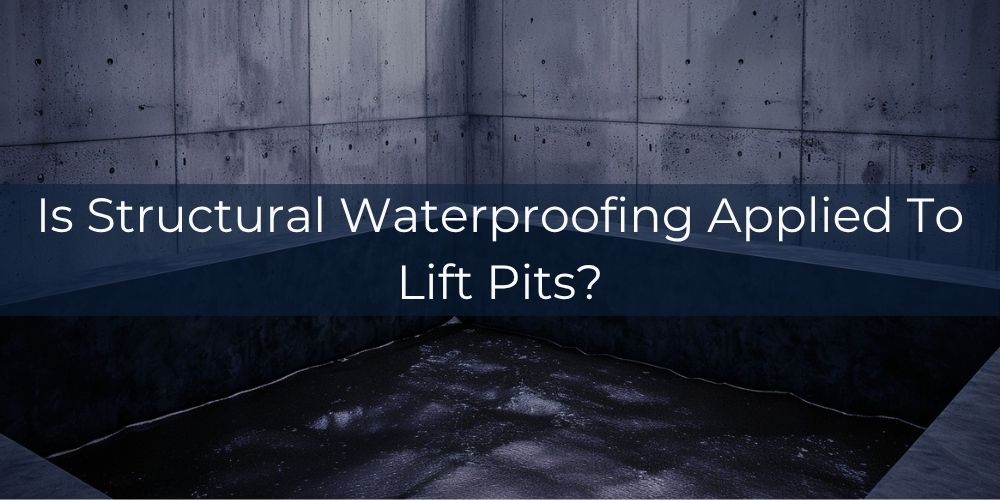
Structural waterproofing is applied to lift pits in UK buildings where lift pit chambers, pit bases, pit walls, wall-to-base junctions, kicker joints, sump recesses, drainage pockets, service penetrations, return faces, and other confined below-ground pit elements require continuous protection against groundwater ingress, damp migration, hydrostatic loading, seepage concentration, and concealed moisture-related damage. It is applied to lift pits because a lift pit is not simply a small part of the basement. It is a recessed low-point chamber within the substructure where water pressure, seepage tracking, and interface weakness can concentrate within a tight footprint. Structural waterproofing is therefore used as a lift pit protection system carried across the full pit chamber rather than as a local patch, isolated coating, or detached barrier strip. This lift-pit-specific deployment matters because water acts on a lift pit as a confined recess. It can press against pit walls, rise beneath the pit base, collect at the lowest point of the chamber, exploit service entries, and track through weak wall-to-base transitions, sump details, or internal corners. Structural waterproofing is applied to lift pits because these risks are generated by the pit’s position as a recessed, low-level, enclosed chamber within the below-ground structure. Once a formed recess becomes part of the lift pit, it requires protection that follows the pit geometry, the pit base footprint, the internal returns, and the concealed tie-ins around the chamber. In UK projects, structural waterproofing only performs effectively in lift pits when the application scope reflects the whole pit chamber rather than selected visible areas of concrete. That is why lift pit waterproofing has to be organised around water-risk appraisal, pit depth, chamber geometry, confined-access buildability, substrate readiness, interface ownership, sequence planning, and traceable installation control. Structural Waterproofing delivers the works needed to apply structural waterproofing to lift pits, including waterproofing strategy development, barrier formation, joint defence, penetration sealing, substrate preparation, membrane installation, coating application, interface detailing, remedial leak investigation, and phased waterproofing works in restricted or access-limited pit environments. The objective is not simply to waterproof part of a recess. The objective is to create one continuous protective layer across the lift pit chamber, the pit base, and the pit-specific interfaces that affect long-term performance. This is also why records form part of the lift pit application strategy rather than sitting outside it. Waterproofing zone schedules, continuity logs, penetration-sealing evidence, joint-treatment records, chamber-interface checks, and as-built documentation all help show where lift pit waterproofing was installed and how continuity was carried through the chamber. By combining controlled pit deployment, low-point continuity, coordinated detailing, and evidential closeout, structural waterproofing is applied to lift pits in a way that supports long-term protection across UK buildings.
What Lift Pit Elements Is Structural Waterproofing Applied To?
Structural waterproofing is applied to lift pit elements that form part of the recessed pit chamber and therefore sit within direct water-exposed conditions. In UK buildings, this most commonly includes pit walls, pit bases, wall-to-base junctions, kicker joints, internal corners, return faces, sump recesses, drainage pockets, service-entry points, thresholds, penetrations, terminations, and other confined pit details that shape the lift pit protection line. These are the parts of the structure where waterproofing has to continue across vertical pit faces, the horizontal pit base, and the directional changes inside the chamber rather than stopping at isolated areas of accessible surface. This means structural waterproofing is applied across more than one pit condition. It can be carried over the pit base, up the pit walls, through internal corners, around sump recesses, across kicker joints, through service-entry details, and at transitions where the horizontal base waterproofing meets vertical protection at the chamber wall or return. In each case, the application is determined by the fact that the element belongs to the same confined pit chamber and therefore has to remain continuous with adjoining lift pit protection zones. Typical structural waterproofing systems may include barrier membranes, coatings, joint-sealing elements, penetration seals, puddle flanges, transition details, terminations, and substrate-preparation measures. These are only effective in lift pits when they operate together as one coordinated chamber-wide protective assembly. A pit wall does not remain protected if the pit base tie-in is unresolved. A sump recess does not stay dry if adjoining penetrations remain weak. A lift pit base does not complete the system if continuity is lost at a kicker joint or at an internal corner return. Structural waterproofing is therefore applied to lift pit elements that require linked protection across the full pit chamber. In practical terms, structural waterproofing is applied to any lift pit zone where low-point water concentration, confined geometry, chamber continuity, or pit-specific interface risk make isolated treatment inadequate. That is why its use extends across pit elements and the interfaces between them rather than remaining confined to one face, one corner, or one local defect.
Why Is Structural Waterproofing Applied to Lift Pits?
Structural waterproofing is applied to lift pits because lift pits are exposed to water in ways that larger below-ground spaces are not. Groundwater pressure, perched water, seepage concentration, low-level moisture collection, buried contact zones, and movement at confined pit junctions all act directly on the pit chamber. Structural waterproofing is therefore applied to lift pits because the pit base and pit walls require a continuous protective response to conditions generated by their position as the lowest enclosed recess within the substructure. This becomes most obvious at pit interfaces. Wall-to-base junctions, kicker joints, sump details, service penetrations, internal corners, return faces, membrane stops, and transitions between horizontal and vertical waterproofing zones all sit within locations where pit continuity can fail if the protection is not carried through properly. Once continuity breaks in one of these areas, water can move past the protective line, collect in the chamber, track across adjoining pit elements, and create concealed failure routes within the recess. Structural waterproofing is applied to lift pits because those pit-specific interfaces cannot be protected reliably through patch treatment or isolated product use. UK projects also intensify the need for pit-specific application. Deep recess geometry, constrained working space, refurbishment interfaces, dense service coordination, variable groundwater conditions, and programme pressure all affect how waterproofing must be deployed across the pit chamber. Structural waterproofing is applied to lift pits by aligning risk assessment, pit form, application method, detailing logic, substrate readiness, sequencing, and verification into one coordinated protection strategy. When those parts are aligned, the lift pit is more likely to receive continuous and maintainable protection across the full chamber.
Lift pit waterproofing only works when the protective system is applied across the full pit chamber and across the interfaces where low-point water pressure or seepage concentration is most likely to bypass local protection.
- Structural Waterproofing applies structural waterproofing to lift pits by defining the application scope around the full pit chamber rather than isolated areas of pit concrete.
- Structural Waterproofing targets pit control points such as wall-to-base junctions, kicker joints, sump recesses, internal corners, service penetrations, thresholds, terminations, and return faces because these determine whether pit continuity is maintained.
- Structural Waterproofing selects systems according to groundwater exposure, low-point pressure, substrate reality, pit geometry, and confined-access conditions so the installed waterproofing suits the actual lift pit chamber.
- Structural Waterproofing manages preparation, sequencing, access, and trade coordination so the pit protective line is not broken during installation.
- Structural Waterproofing records installed works through inspection evidence and closeout documentation so the lift pit waterproofing scope remains traceable after completion.
These decisions produce the following lift pit protection and assurance outcomes.
- Pit-chamber scope control links pit walls, pit bases, sump recesses, service-entry points, internal corners, penetrations, terminations, and returns into one coordinated chamber-wide system, so structural waterproofing is applied across the full lift pit rather than in disconnected patches.
- Pit-interface control secures the concealed details where continuity most often fails, so local lift pit weaknesses are less likely to develop into broader hidden ingress routes.
- Condition-matched pit system selection aligns the waterproofing approach with groundwater conditions, low-point exposure, chamber geometry, and interface complexity, so the installed system is better matched to the actual lift pit.
- Construction-stage pit continuity preservation protects installed pit details through staging, access control, and trade overlap, so chamber continuity is less likely to be lost before handover.
- Evidence-based pit verification records where waterproofing was installed and how pit interfaces were resolved, so the lift pit protection system can be checked, governed, and maintained over time.
The process below follows that same sequence, moving from pit scope definition and chamber-interface control through system selection, continuity preservation, and evidenced closeout.
1. Define the Waterproofing Boundary Around the Full Lift Pit Chamber
Structural waterproofing only begins to function properly in lift pits when the project defines the waterproofing boundary around the whole pit chamber. If the scope covers obvious pit faces while leaving sump recesses, penetrations, internal corners, returns, kicker joints, or base-to-wall interfaces unresolved, the result is not a coherent pit system. It is a fragmented application. Structural Waterproofing defines the lift pit waterproofing boundary across all credible chamber-risk locations so the installed works form one connected protective chamber.
2. Secure the Pit Interfaces Where Chamber Continuity Is Most Fragile
Most lift pit waterproofing failures begin at concealed chamber interfaces rather than open accessible faces. Wall-to-base junctions, internal corners, sump details, service entries, kicker joints, membrane stops, and return transitions are the places where pit continuity is most exposed to failure. These are also the places where water can bypass apparently competent field protection through recess conditions or interface weakness. Structural Waterproofing prioritises these pit interfaces because successful lift pit deployment is governed by whether these locations remain inside the protective line.
3. Match the Waterproofing System to the Actual Pit Exposure Zone
A lift pit waterproofing system has to suit the conditions in which it is actually being applied. Groundwater pressure, seepage intensity, low-point exposure, substrate variability, penetration density, pit depth, chamber geometry, and construction tolerances all influence which waterproofing approach is appropriate. Structural Waterproofing matches the system to those conditions so the selected solution is not only technically credible, but also suitable for the pit chamber and the location-specific water exposure acting on the recess.
4. Preserve Pit Continuity Through Sequencing and Site Control
Protective continuity can be designed correctly and still fail during delivery if pit details are damaged, bridged, contaminated, bypassed, or concealed during construction. Temporary works, service installation, restricted access, follow-on trades, and sequencing errors all create that risk. Structural Waterproofing preserves lift pit waterproofing integrity by coordinating preparation, staging, access, protection, and interface management so the pit protective line remains continuous throughout the works.
5. Verify Where and How Structural Waterproofing Was Applied to the Lift Pit
A lift pit waterproofing installation cannot be treated as complete unless chamber continuity can still be evidenced after critical details are concealed. Structural Waterproofing records continuity formation, joint treatment, penetration sealing, interface resolution, and as-built layout information so the finished works can be checked against the intended pit protection boundary. That evidence helps show that structural waterproofing was not simply used somewhere in the substructure. It was applied across the lift pit in a controlled, continuous, and traceable way.
How Does Structural Waterproofing Protect Lift Pit Continuity?
Structural waterproofing protects lift pit continuity by keeping the pit chamber waterproofing route unbroken across the parts of the recess most exposed to water pressure, seepage concentration, and construction vulnerability. In UK buildings, a lift pit does not fail only because water is present around it. Failure begins when continuity is lost at wall-to-base junctions, kicker joints, sump recesses, internal corners, service penetrations, return faces, thresholds, or other pit-specific interfaces that allow water to pass beyond the intended protective line. Structural waterproofing therefore protects lift pit continuity by holding these chamber details together as one uninterrupted waterproofed recess rather than leaving them to behave as isolated weak points. This continuity role matters because a lift pit is a connected low-point chamber, not a random collection of concrete surfaces. Water can bear against pit walls, rise beneath the pit base, collect within the lowest recesses, track around internal corners, and exploit breaks at penetrations or chamber returns. If one part of the pit system is left unresolved, the weakness can spread beyond that local point and compromise adjoining pit areas that may otherwise appear sound. Structural waterproofing protects lift pit continuity because it prevents those interruptions from breaking the linked waterproofing route that the pit chamber depends on. In practice, this means pit continuity is protected by more than coating the base or lining a wall face. The waterproofing has to remain connected through pit walls, pit bases, wall-to-base transitions, sump details, service-entry points, return faces, threshold conditions, and transitions into adjoining waterproofing zones. Structural Waterproofing protects lift pit continuity by coordinating chamber-wide coverage, corner detailing, junction treatment, penetration sealing, and low-point tie-ins so the finished lift pit remains one joined protective chamber rather than a patched recess with multiple break points.
Structural Waterproofing protects lift pit continuity by making sure that pit walls, pit bases, and pit interfaces remain part of one uninterrupted protective route from the lowest point of the chamber to every adjoining return and junction.
- Structural Waterproofing protects lift pit continuity by carrying waterproofing across the pit base, pit walls, wall-to-base connections, internal corners, and return faces as one linked chamber-wide system.
- Structural Waterproofing protects lift pit continuity by securing kicker joints, sump recesses, penetrations, thresholds, terminations, and other pit interruptions before they become break points in the protective line.
- Structural Waterproofing protects lift pit continuity by selecting systems that suit groundwater pressure, low-point exposure, chamber geometry, recess depth, and interface density across the lift pit zone.
- Structural Waterproofing protects lift pit continuity by preserving installed pit details through preparation, sequencing, protection, access management, and trade coordination during lift pit works.
- Structural Waterproofing protects lift pit continuity by recording how pit waterproofing was formed, tied in, checked, and closed out so the completed chamber system remains traceable after concealment.
These lift-pit-continuity decisions produce the following protection and assurance outcomes.
- Joined chamber coverage keeps the main lift pit recess within one connected waterproofing route, so the pit is less likely to behave as fragmented protected and unprotected areas.
- Low-point continuity control secures the pit base, sump recesses, and wall-to-base tie-ins, so concentrated water pressure is less able to exploit an unresolved chamber junction.
- Interface-break prevention protects corners, penetrations, thresholds, returns, and terminations, so local pit disruptions are less likely to become active seepage paths.
- Construction-stage continuity retention protects pit waterproofing from damage, bridging, contamination, or accidental bypass during delivery, so the chamber line is less likely to fail before handover.
- Traceable pit closeout records how continuity was formed across the pit chamber, so the installed lift pit waterproofing can be checked, governed, and maintained over time.
The continuity sequence below follows that same logic, moving from chamber connection and low-point control through interruption-point sealing, construction-stage retention, and traceable closeout.
1. Keep the pit chamber connected as one waterproofed recess
Structural waterproofing protects lift pit continuity by treating the pit chamber as one connected waterproofed recess rather than as separate treated faces. If waterproofing is present on parts of the pit but does not remain joined across the wider chamber, the result is not true continuity. It is fragmented protection. Structural Waterproofing keeps the chamber connected by extending the waterproofing route across the full recess so the lift pit operates as one protected chamber.
2. Hold the pit base and wall returns inside the same protective route
Lift pit continuity is often lost at the base and at the internal turns of the chamber rather than in the middle of open wall faces. Pit bases, wall-to-base junctions, internal corners, return faces, and sump recesses are the locations where water can exploit a weak transition if the protective route is not maintained. Structural Waterproofing protects lift pit continuity by holding these low-point and return details inside the same linked waterproofing arrangement as the wider chamber itself, so the pit does not lose protection where one chamber surface changes direction into another.
3. Seal penetrations and pit-level interruptions before they fragment the chamber
Service penetrations, kicker joints, threshold details, membrane stops, sump interfaces, and similar pit-level interruptions are the places where a continuous chamber can quickly become a broken waterproofing field if detailing is incomplete. These are not minor add-ons to the lift pit. They are the most common points at which chamber continuity is tested. Structural Waterproofing protects lift pit continuity by resolving these interruption points as integral parts of the pit system, not as isolated afterthoughts applied once the main chamber surfaces are already complete.
4. Preserve pit continuity through sequencing and site management
Even correctly formed pit continuity can be lost during construction if installed details are damaged, bridged, contaminated, bypassed, or concealed before they are protected and checked. Temporary works, service installation, restricted access, follow-on trades, and sequencing errors all increase this risk. Structural Waterproofing protects lift pit continuity by coordinating preparation, staging, access, protection, and interface management so the chamber-level protective route stays intact through the construction process.
5. Prove that pit continuity was maintained after the critical details were concealed
Lift pit continuity cannot be treated as dependable unless the finished waterproofing route can still be evidenced after critical junctions, recesses, penetrations, and chamber interfaces are no longer visible. Structural Waterproofing protects lift pit continuity by recording continuity formation, joint treatment, penetration sealing, low-point tie-ins, and as-built layout information so the installed pit system can be checked against the intended waterproofing route. That evidence helps show that the lift pit was not just waterproofed in places. It was protected as one continuous and traceable chamber-wide system.
Have a question about an upcoming project?
What Usually Prevents Structural Waterproofing from Being Applied Correctly to Lift Pits?
Structural waterproofing is usually prevented from being applied correctly to lift pits when the waterproofing no longer follows the full pit chamber as one continuous and coordinated low-point protective deployment. In UK buildings, incorrect lift pit application rarely begins because every part of the pit waterproofing is omitted at once. It more often begins when one or more chamber details fall outside the intended pit-protection boundary, remain unresolved, or are later compromised in a way that breaks continuity across the recessed chamber. That weakness may occur at a wall-to-base junction, kicker joint, sump recess, internal corner, return face, service penetration, threshold, membrane stop, drainage pocket, or transition between adjoining waterproofing planes. Once that happens, the problem is no longer simply that one local pit detail is weak. It is that the waterproofing is no longer being applied to the lift pit as one connected chamber-wide protection system. This matters because lift pit application is governed by chamber continuity, not by isolated product presence. A membrane on one pit wall does not mean the lift pit has been waterproofed correctly if the pit base tie-in remains unresolved elsewhere. A coating across one recess face does not create correct pit application if a sump recess, internal corner return, or service-entry detail still leaves a break in the protective line. A kicker joint, threshold condition, return face, or low-point recess may appear secondary in isolation, yet these are the exact places where lift pit waterproofing most often fails to carry through the full chamber. Structural waterproofing is therefore prevented from being applied correctly to lift pits whenever local discontinuity stops the application from behaving as one joined recessed protective field. In practice, incorrect lift pit application is most often caused by incomplete scope, weak chamber detailing, broken continuity, unsuitable substrates, later trade damage, or missing verification of the concealed details that are supposed to hold the recess-wide waterproofing route together. A pit wall may be treated while the pit base remains weak. A sump recess may be protected while adjoining penetrations remain unresolved. A return face may sit within the same chamber while the connected internal corner or wall-to-base tie-in fails to carry the same protective logic. A concealed waterproofing run may appear complete in principle but remain unverified in practice. Structural Waterproofing therefore treats lift pit application failure as a chamber-continuity problem rather than as a local recess-installation problem, because the real question is whether the waterproofing was actually carried across the full lift pit chamber, the pit base, and the pit-specific interfaces in the way the project required.
Structural waterproofing is usually prevented from being applied correctly to lift pits when the chamber-protection line breaks at the exact details where low-point exposure, recess geometry, internal returns, and concealed pit interfaces require the waterproofing to remain continuous from one part of the lift pit chamber to the next.
- Structural Waterproofing identifies missing lift pit scope as an application failure because untreated chamber areas leave parts of the recessed protective zone outside the intended waterproofing boundary.
- Structural Waterproofing treats incomplete continuity as a lift pit application risk because partially connected systems still leave wall-to-base junctions, sump recesses, internal corners, return faces, penetrations, thresholds, terminations, and chamber transitions outside the same chamber-wide protective line.
- Structural Waterproofing treats broken waterproofing as a lift pit application failure because punctured, displaced, bridged, bypassed, or otherwise compromised details disconnect one pit protection zone from another.
- Structural Waterproofing focuses on continuity-sensitive pit interfaces because local failure at concealed chamber junctions is the point where correct lift pit deployment most often starts to fragment.
- Structural Waterproofing treats unverified concealed works as an application-governance risk because pit defects are harder to confirm once later stages have enclosed, covered, or restricted access to the chamber.
These lift pit application failures produce the following structural and waterproofing consequences.
- Pit-chamber fragmentation breaks the waterproofing deployment into separate treated parts, so the lift pit is less protected as one continuous recessed chamber.
- Low-point and return continuity loss allows local weakness at pit bases, internal corners, return faces, and sump details to undermine adjoining waterproofing runs, so the wider pit application becomes less stable.
- Bypass-enabled chamber vulnerability allows water to move past isolated weak details instead of being controlled across the intended pit-wide protective line, so local defects are more likely to become wider lift pit ingress paths.
- Concealed recess weakness allows hidden discontinuities to remain active within corners, around penetrations, and at low-point interfaces without early visibility, so the application problem is more likely to deepen before intervention occurs.
- Reduced confidence in lift pit deployment undermines trust that the installed waterproofing was actually carried across the full lift pit chamber as intended, so long-term pit protection becomes less dependable.
The lift pit application-failure sequence below follows that same logic, moving from missing scope and chamber continuity loss through local breakdown, concealed weakness, and wider loss of correct pit-wide deployment.
1. Missing waterproofing leaves parts of the lift pit chamber outside the application boundary
Structural waterproofing stops being applied correctly to lift pits when parts of the pit chamber are left outside the intended waterproofing boundary. Pit walls, pit bases, sump recesses, internal returns, threshold zones, service-entry details, and adjoining chamber tie-ins may then remain directly exposed without being brought into the same protective logic as the surrounding recess. Structural Waterproofing treats this as a lift pit application failure from the outset because waterproofing cannot be said to have been correctly applied to a lift pit if part of the chamber has been left untreated.
2. Incomplete waterproofing breaks the chamber continuity required for correct pit application
Structural waterproofing is also prevented from being applied correctly to lift pits when it is present in some locations but incomplete across the full pit chamber. This commonly occurs where visible pit faces are treated but pit bases remain weak, where low-point recess areas are protected but penetrations are unresolved, or where adjoining waterproofing zones fail to tie together properly across chamber corners and returns. Incomplete continuity does not produce correct lift pit application in any dependable sense. It creates a fragmented recessed assembly in which some parts of the chamber are protected and others still allow continuity failure. Structural Waterproofing therefore treats incomplete waterproofing as a system-level lift pit application defect rather than as a minor local omission.
3. Broken waterproofing disconnects one lift pit protection zone from another
Even where waterproofing was originally appropriate, it can stop being correctly applied to a lift pit if the installed protection becomes broken during or after construction. Puncture, displacement, bridging, contamination, trade damage, substrate failure, or poor reinstatement can disconnect a previously continuous pit detail from the adjoining pit protection field. Once that happens, the issue is not simply that one local recess detail has degraded. It is that the chamber deployment has lost continuity at a point that may now allow water to bypass otherwise competent pit protection. Structural Waterproofing treats broken waterproofing as a lift-pit application failure because correct pit deployment depends on connected performance across the full chamber, not isolated local treatment.
4. Weak pit interfaces allow local defects to expand into wider chamber failure
Lift pit application failure rarely stays confined to the original detail. It is more likely to spread where continuity weakens at wall-to-base junctions, kicker joints, sump recesses, internal corners, return faces, penetrations, thresholds, membrane stops, and other concealed pit control points. At these locations, local discontinuity can expose adjoining areas that depend on the same chamber-wide protective framework to remain secure. Structural Waterproofing concentrates heavily on these points because they are the places where local detailing weakness most often becomes wider loss of correct lift pit application across the recessed waterproofing chamber.
5. Concealed and unverified defects make incorrect pit application harder to detect and harder to prove
Structural waterproofing is less able to be confirmed as correctly applied to lift pits when concealed works are not supported by clear records showing what was installed, how continuity was formed, and whether critical pit details were actually resolved. Once waterproofing is buried, enclosed, or covered by later construction, uncertainty itself becomes a lift pit application risk because hidden defects are harder to identify before they begin undermining the wider chamber. Structural Waterproofing treats verification as part of correct lift pit application for this reason. Without continuity records, joint-treatment evidence, penetration-sealing confirmation, chamber-interface checks, and as-built information, the lift pit is more exposed not only to water-related vulnerability, but also to delayed diagnosis and more disruptive corrective work later.
When Should Lift Pit Structural Waterproofing Be Assessed?
If a lift pit has recurring leakage, suspected seepage concentration, unresolved damp transmission, hydrostatic pressure exposure, or uncertainty around waterproofing continuity at wall-to-base junctions, kicker joints, sump recesses, internal corners, return faces, service penetrations, thresholds, membrane stops, or other concealed chamber-control details, lift pit Structural Waterproofing should be assessed before local pit defects develop into wider chamber failure. Lift pit application risk is rarely defined by visible moisture symptoms alone. Pit bases, pit walls, sump recesses, return faces, service-entry points, internal corners, and other chamber-critical details often lose continuity first at the concealed locations where the waterproofing may not have been carried, tied in, protected, or verified as intended. On new-build and refurbishment projects, delayed action also increases technical and programme risk by allowing incomplete scope, inaccessible defects, substrate weakness, sequencing drift, trade-interface damage, and concealed continuity breaks to become harder to diagnose and more difficult to correct once the pit works are enclosed, fitted out, or operational. Lift pit Structural Waterproofing should therefore be assessed as a complete chamber-application condition under real site circumstances, using evidence-led review of groundwater behaviour, pit form, low-point exposure, substrate readiness, continuity risk concentration, and the concealed pit details most likely to fall outside the intended lift pit protection boundary. This allows local defects, chamber continuity weakness, missing application scope, and unresolved pit interfaces to be understood as system-level lift pit application problems rather than isolated damp symptoms or repeat local leaks. Where required, the next technically correct step may be lift pit waterproofing review, chamber-interface investigation, substrate assessment, targeted remedial correction, or a coordinated lift pit protection strategy for wider structural control. If your project has recurring moisture symptoms, uncertain lift pit detailing, missing waterproofing records, incomplete evidence of continuity, or any doubt about whether Structural Waterproofing was correctly applied across the full lift pit chamber, request a lift pit waterproofing assessment or project scope review to determine the correct technical pathway for the works.